Is this art? Yes, in my opinion. For sure, it is not fine art. It is not even decorative art. It is provocative. It was meant as a challenge to the wider world.
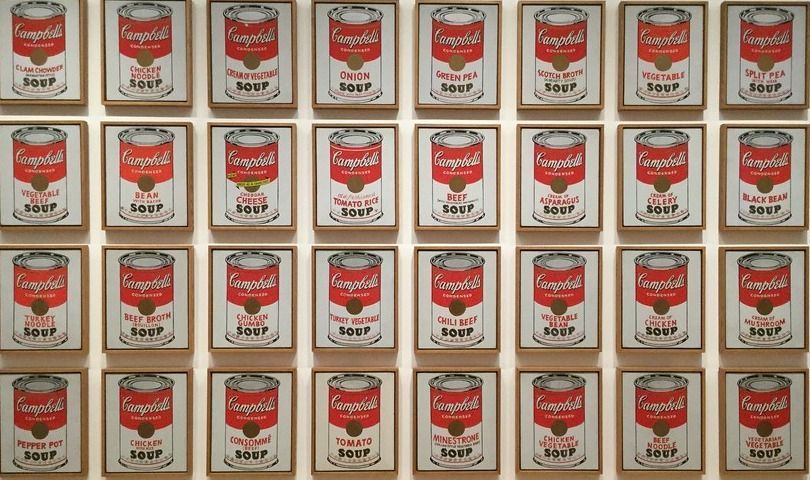
Anecdotal evidence indicates that Muriel Latow - a gallery owner in Manhattan - suggested to Andy Warhol, in an apparently off-the-cuff manner, that he should paint something that was truly banal and commonplace and which he came across in his own everyday life - like a Campbell's soup can. Warhol was later to claim that he ate Campbell's soup every day for twenty years. Whether this is true or not, he did begin to 'paint' a series of 32 soup cans in late 1961 and early 1962. Almost identical, the only notable difference between the cans was the reference to their contents: PepperPot, Chicken, Consomme etc.
The Pop Art movement had begun in the mid-1950s in Britain and reached America very soon afterwards. Inspired by popular and commercial culture, Pop Art concerned itself with 'Popular, Transient, Expendable, Low Cost, Mass produced...' (Richard Hamilton, 1957) subject matter.
There are countless books and essays on the subject of Pop Art and Andy Warhol and I am not going to attempt to offer any real or comprehensive explanation of his Soup Cans or of their meaning or significance, or indeed to comment on Warhol's fascination with consumerism and celebrity, as well as contemporary social and political issues,
Instead, I am going to concentrate on a single aspect of the pattern of my thinking as a response to Warhol's Soup Can series - the idea of 'choice'.
At first glance all the soup cans seem the same. On closer inspection, we realise that each can contains a different flavour. It seems as if we each have the freedom to choose the flavour that we want. In fact, Warhol is asking us to consider the idea of proscription. Giant corporations have already largely decided where the cans can be bought, in supermarkets for example. The brands are restricted, Campbell or Heinz for instance. We can 'choose' Pepper Pot, but only because they have decided to offer it.
Warhol is inviting us to consider the world we live in and the constant restrictions imposed on us in almost every area of life.